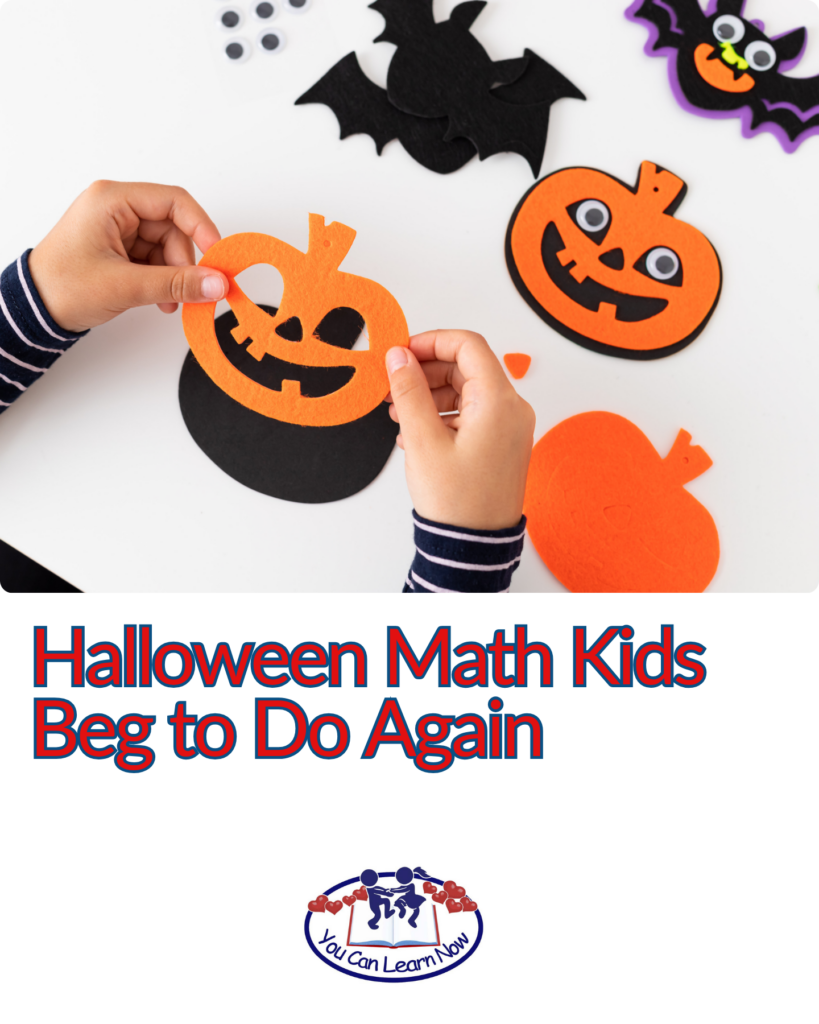
October has a way of solving problems teachers didn’t even know they had. A lesson that would normally get a groan from a room full of five-year-olds turns into something kids beg to do again the second you put a plastic pumpkin, a paper bat, or a googly-eyed monster next to it. That seasonal magic is exactly why Halloween is such a good excuse to sneak in some serious math work disguised as a party.
Shape recognition is one of those skills that sounds simple from the outside and turns out to matter far more than most parents realize. Long before a child is asked to identify a hexagon in an activity, shape knowledge is quietly laying the groundwork for how they read letters, judge distance, and eventually make sense of fractions and geometry. This is where fine motor activities earn their place in the classroom too, because tracing, cutting, and building shapes with small hand movements is what actually cements the concept, far more than looking at a shape on a poster ever could.
Why Fine Motor Activities Are the Best Way to Teach Shape Names and Attributes
It is tempting to treat shapes as a kindergarten warm-up, something to breeze through before moving on to counting and letters. The National Council of Teachers of Mathematics pushes back hard on that idea, and for good reason.
Early geometry work, including naming shapes and describing their attributes, such as counting sides or noticing corners, builds the spatial reasoning children rely on later for everything from map reading to algebra. A child who can tell you a triangle has three straight sides and three corners is not just memorizing a fact. They are learning to look closely, compare, and describe what they see in precise language, which is a skill that carries into reading and science just as much as math.
The National Association for the Education of Young Children has written about how young children build math understanding best through hands-on exploration rather than worksheets alone. Shapes are one of the easiest concepts to hand to little fingers. Building a shape out of craft sticks, tracing its outline, or cutting one out with scissors gives a child a physical memory of what a square feels like, not just what it looks like, and that physical memory tends to stick longer than anything read off a flashcard.
Fine motor activities do double duty here. The CDC’s guidance on early childhood development notes that skills like cutting along a line, coloring inside a shape, or gluing small pieces into place are exactly the kind of hand strength and coordination practice four- and five-year-olds need heading into kindergarten writing tasks. Pairing that fine motor practice with shape and math learning means a single activity is quietly building two skill sets at once, which is about as efficient as classroom time gets.
There is also a visual-spatial piece worth naming. Understood.org‘s explanation of visual-spatial skills points out that recognizing and manipulating shapes is one of the earliest, clearest windows a teacher gets into how a child processes spatial information, which later affects everything from map reading to organizing work on a page. A child who struggles to tell a rectangle from a square is not being careless. They may genuinely need more hands-on practice manipulating shapes before the distinction clicks, and fine motor activities like tracing and cutting give them exactly that kind of low-pressure repetition.
A Halloween Math Activity Built Around Fine Motor Activities
Here is the one that tends to become a classroom favorite every October. Give each child a page of Halloween shapes, a pumpkin, a bat, a ghost, or a spider built entirely from basic shapes like circles, triangles, and rectangles. Their job is to find and name every shape hiding inside the picture, then describe one attribute of each one out loud to a partner or the group. A triangle bat wing has three sides. A round pumpkin body has no corners at all. It sounds simple, but the combination of hunting for shapes, naming them correctly, and explaining why they count as that shape is exactly the kind of active reasoning that sticks.
From there, let the fine motor work take over. Have children trace the shapes with a crayon, cut them out along the lines, and rebuild their own Halloween creature by gluing the pieces onto construction paper in a new arrangement. Every part of that sequence, tracing, cutting, gluing, and arranging, reinforces the shape names and attributes they just practiced out loud, while also giving their hands the kind of repetitive, purposeful movement that builds real fine motor strength. It plays like a craft, but it is doing the quiet work of math and small motor development at the same time, which is exactly why it holds a class’s attention when a plain worksheet would not.
Teachers looking for a version of this that is already built and ready to hand out will find it in the Shape Monster Book, which walks kids through naming and building two-dimensional shapes using silly monster characters that make the repetition feel like play instead of practice. It is the kind of resource that turns a five-minute filler activity into something a class actually asks to do again the next day.
Why Fine Motor Activities Matter Beyond October
The seasonal wrapping paper is fun, but the underlying skill is worth protecting all year. Shape vocabulary and attribute knowledge show up again and again in early elementary math, from sorting activities to early fraction work. Children who struggle to name and describe basic shapes in kindergarten often carry that gap forward into first and second grade geometry units. Catching it early, while it still feels like a game, is far easier than reteaching it later once it has become a source of frustration.
The same logic applies to fine motor skill building. A child who has had plenty of low-stakes practice cutting, tracing, and gluing walks into first grade with steadier hands for writing, which makes everything from spelling tests to writing time less physically exhausting. We talked about how this kind of hands-on, screen-free practice compares to digital learning tools in our post on [screen time versus real time](INSERT BLOG LINK), and shape-based crafts like this one are a perfect example of the real time side of that equation. There is a reason a pair of safety scissors and a sheet of construction paper still outperforms an app for building this particular skill.
It is also worth remembering that this kind of learning does not have to stay confined to a desk. The same shape-hunting instinct that makes a Halloween activity fun works just as well outdoors, spotting circles in tree stumps or triangles in fallen branches during recess, which is one more reason we keep coming back to the idea in our post on [why outdoor play matters more than most parents realize](INSERT BLOG LINK).
Math is not just a subject taught at a table. It is a way of noticing the world, and October gives teachers one of the easiest excuses all year to make that noticing feel like a party instead of a lesson.