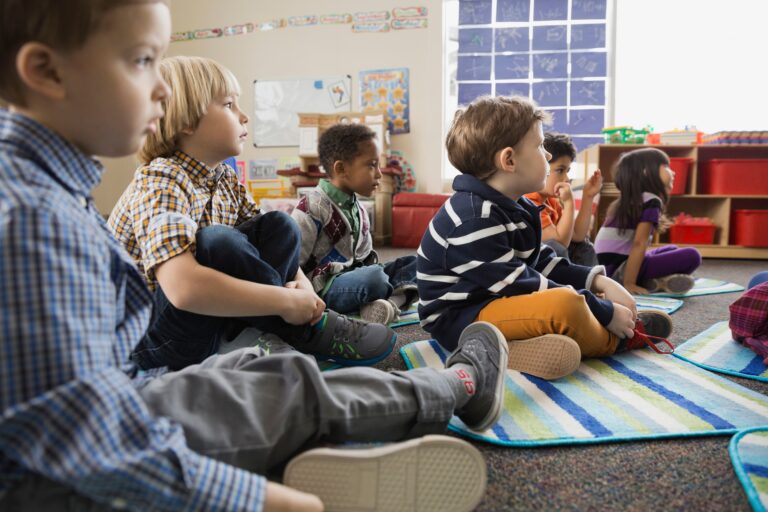
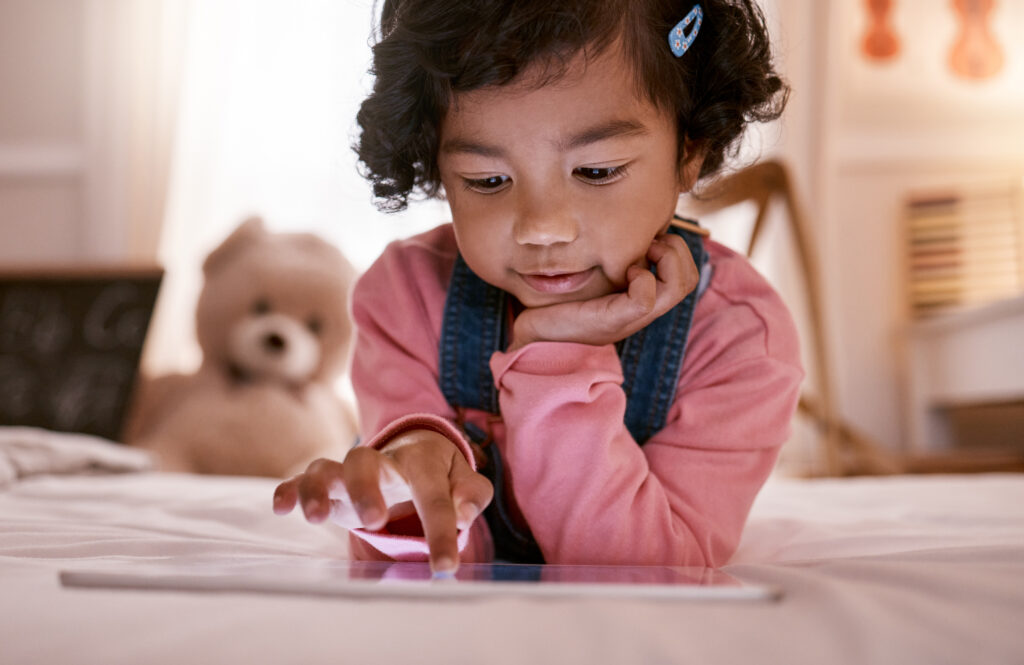
If you teach PreK through third grade in the year 2026, you are navigating something teachers before us never had to think about: a generation of students who arrived in your classroom already fluent in swiping.
The questions about technology in early childhood classrooms are real and ongoing. Should we use tablets at centers? Is the SmartBoard helping or hurting? Are educational apps actually educational? After many years of watching trends come and go, I want to share what the research actually says — because the truth is more nuanced than either the “screens are ruining childhood” camp or the “but it’s the future!” camp would have us believe.
What the Research Actually Says About Young Children and Screens
Let’s start with the guidelines from the people whose job it is to study this. The American Academy of Pediatrics recommends no screens at all (other than video chat) before 18 months, and for children ages 2 to 5, no more than an hour a day of high-quality programming. The World Health Organization echoes those numbers, recommending less than an hour of screen time daily for children ages 2 to 5 and emphasizing that less is better. These guidelines exist because, as Mayo Clinic clinicians summarize, unstructured playtime is more valuable for a young child’s developing brain than electronic media, and excessive passive screen exposure has been linked in systematic reviews to slowed language development, poorer sleep, attention problems, and reduced executive function.
That said, the AAP has updated its language in recent years to prioritize quality, context, and conversation over rigid time limits — recognizing that not all screen time is created equal. And that distinction is the most important thing for us to understand as classroom teachers.
Passive vs. Active: The Most Important Distinction You’ll Make
Here’s where we as educators have actual leverage. The research is increasingly clear that passive screen time and active screen time are not the same thing. A recent review in Frontiers in Psychology found that passive screen time — the kind where a child sits and watches without interacting — is consistently associated with weaker attention in preschoolers, while active, interactive screen use shows a more mixed picture, with some forms supporting orienting attention and skill-building.
As speech-language professionals at Expressable summarize, passive screen time has been linked to language delays. One study found each additional hour of daily videos in toddlerhood reduced expressive vocabulary by six to eight words, while active, co-engaged screen use looks very different.
In a classroom, this distinction matters enormously. A child watching a fifteen-minute educational video in silence is having a fundamentally different cognitive experience than a child collaborating with a peer to solve a problem on an interactive math app, or recording themselves reading a story they wrote, or video-calling a class buddy in another state. As Pearson’s review of school technology explains, active screen time can support digital literacy, problem-solving, and higher-order thinking when used intentionally — while passive screen time tends toward disengagement and missed learning opportunities.
What NAEYC Says About Technology in the Early Childhood Classroom
The joint position statement from NAEYC and the Fred Rogers Center (yes — that Fred Rogers) is the gold standard for our field, and it’s worth reading in full. The statement recognizes that, when scaffolded by an adult and used responsibly and intentionally, technology can be a tool for supporting children’s development. NAEYC’s updated developmentally appropriate practice guidance is equally clear that there is no evidence that development is enhanced when children younger than two independently use devices, but that for older preschoolers and primary-grade children, technology used as one of many options — not the default — can extend learning. The key words throughout are intentional, scaffolded, and responsive.
Practical Classroom Guidance That Actually Works
So what does this look like Monday morning?
First, audit your current screen use honestly. If your students are watching videos as transition fillers or as reward time, that’s passive use — and it’s the type the research raises the most concern about. Replace it with picture books, songs, stretches, or a class job.
Second, when you do use technology, make it active and social. Two children at a tablet talking about how to solve a puzzle is a richer experience than one child wearing headphones in isolation.
Third, lean on the Common Sense Education early childhood resources for vetting any app or program before using it; their reviews evaluate educational value, age appropriateness, and quality with a rigor most of us don’t have time to replicate ourselves.
Fourth, co-view and co-engage. The NAEYC piece on media and our littlest learners emphasizes that screen experiences become meaningful when adults extend them, pausing to ask questions, connecting on-screen content to real life, and following up with hands-on activities. A five-minute video about caterpillars becomes powerful when followed by an outdoor caterpillar hunt.
Fifth, protect the non-screen experiences that screens can never replace: read-alouds, sensory tables, dramatic play, blocks, art, outdoor time, and unhurried conversations. The Common Sense Media early childhood research has consistently shown that high-quality media use becomes problematic when it displaces these foundational experiences — not because screens are inherently bad, but because young brains build themselves through embodied, relational, multisensory play.
Talking to Families About Balance
Many of us field a steady stream of questions from caregivers about home screen time, and our credibility on this topic depends on practicing what we preach. The American Academy of Child & Adolescent Psychiatry suggests, for children ages 2 to 5, limiting non-educational screen time to about an hour on weekdays, and for ages 6 and up, focusing on healthy habits rather than rigid totals.
We can share these guidelines with families gently and without judgment — recognizing that screens are often a survival tool for stressed parents. The most useful thing we can do is model what high-quality, intentional, brief, co-engaged screen use looks like, and equally model the dozens of joyful, screen-free experiences a young child’s day can include.
The Real Time Question
In the end, the most useful frame I’ve found is this: every minute a young child spends with a screen is a minute they’re not spending in face-to-face conversation, hands-on play, physical movement, or imaginative storytelling — the experiences that grow language, executive function, social skills, and a sense of self.
That doesn’t mean screens are villains. It means our job as PreK–3rd grade teachers is to ensure that real time — relationships, bodies in space, materials in hands, ideas spoken aloud — remains the dominant experience of childhood. Technology can be a useful supporting actor in that story. It just shouldn’t be the lead.
When in doubt, ask yourself: would a slightly-older version of this child be better served right now by a screen, or by another human, an interesting object, or the sky? Most days, in my classroom, the answer chooses itself.