There’s a particular kind of quiet that settles over a car in the school pickup line on the first day. A parent replaying the goodbye scene in their head, wondering if they should have hugged longer or left faster. A kid who cried at drop-off and then, according to the teacher, was completely fine ten minutes later. Nobody warns you how much first day of school anxiety belongs to the parent as much as the child.
Here’s the reassuring part. Separation anxiety and first-day jitters aren’t a problem to be solved before September arrives. They’re a normal, healthy sign that a child has formed a real attachment to the people who love them, and that attachment is exactly what makes the rest of the school year possible. The Child Mind Institute puts it plainly: the goal isn’t to eliminate anxiety, but to help a child manage it. That’s a very different job than making the nerves disappear, and it’s a much more doable one.
Why First Day of School Anxiety Isn’t Something to Fix
A pediatric psychologist at Children’s Hospital of Philadelphia describes separation anxiety as a very important developmental milestone, and a completely healthy one, because it means a child has formed a real attachment and misses the person they’re apart from. According to the CDC, fears and worries are typical in children, and a certain amount of them at any given age is expected rather than concerning. The line moves from ordinary jitters to something worth a closer look only when the fear doesn’t fade over time or starts interfering with school, home, or play.
That distinction matters, because a lot of parents brace for the worst version of first day nerves and then feel like something’s wrong when their child cries at drop-off for a week. It usually isn’t. NAEYC notes that it can take up to ten school days for a child to fully settle into a new routine, which means the rough mornings in week one are often just part of the adjustment, not a sign the transition is failing.
Separation Anxiety in Preschool and Kindergarten: What’s Actually Happening
Separation anxiety in preschool and kindergarten tends to show up in waves rather than a straight line. A child can seem completely fine on day one and then hit a wall two or three weeks in, once the novelty wears off and the reality of the new routine sets in. The American Academy of Pediatrics notes that separation anxiety can pop up repeatedly between infancy and age four, and sometimes even later, so a child who handled kindergarten drop-off well in August but struggles again in October isn’t backsliding. Their brain is just working through the same skill from a new angle.
Part of what’s happening developmentally is that young children are still learning that people who leave do, in fact, come back. Pre-K and Kindergarten teachers describe this as something kids need to practice, not avoid, which is why sneaking out during a distraction, however tempting in the moment, tends to backfire. It skips the part where a child learns they can survive the goodbye and be okay.
Calming Big Feelings Before They Take Over
Calming big feelings starts with naming them. Research on early emotional development is built around a simple idea: when a child can label how they’re feeling, it helps them gain some control over that feeling instead of being swept up in it. A short sentence like “you’re feeling nervous about your new teacher” does more work than it looks like it does, because it tells a child their feeling is real, expected, and not too big to say out loud.
This is also where a parent’s own steadiness matters more than most people realize. Kids co-regulate off of the adults around them, which means a parent who can stay calm during a hard goodbye is quietly teaching their child how to do the same. Pre-K to Kindergarten’s teachers’ guidance on this is worth borrowing almost word for word: offer comfort before correction, and let regulation come first, understanding second. In other words, a crying kid at drop-off doesn’t need a pep talk at that exact moment. They need a steady voice and a hug, and the explanations can come later, at home, when everyone’s nervous system has settled back down.
A Goodbye Ritual That Actually Works
If there’s one piece of advice that shows up across nearly every credible source on this topic, it’s this: keep the goodbye short. The American Academy of Pediatrics is direct about it, noting that a lingering goodbye stretches out the anxiety right along with it, and that returning to check on a child after a hard drop-off often resets the whole cycle instead of easing it.
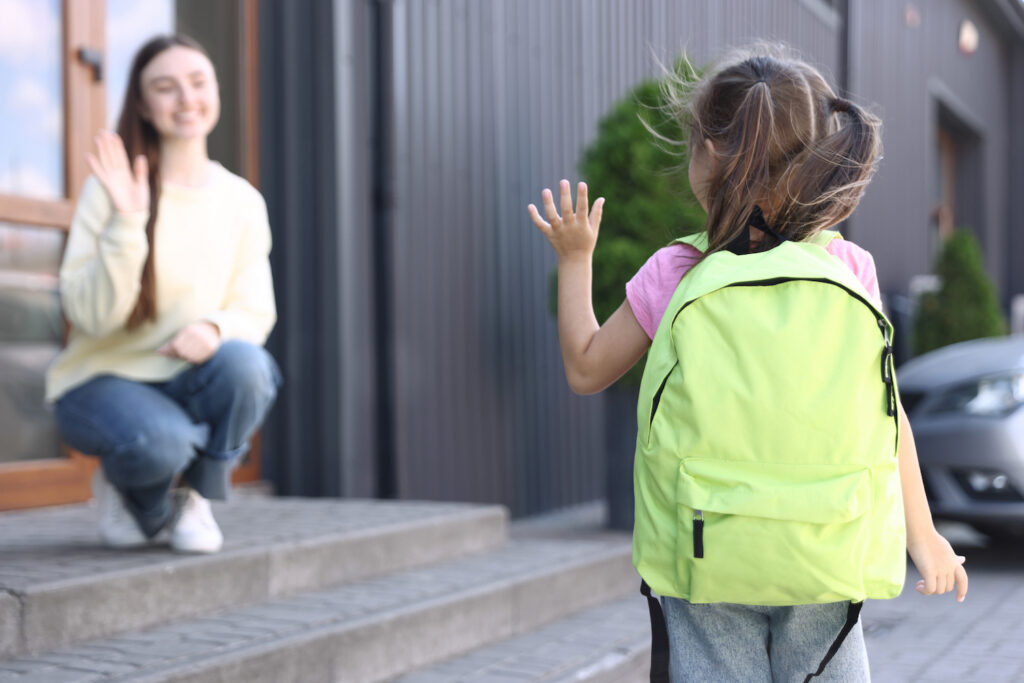
A consistent goodbye ritual solves this without making the moment feel rushed or cold. It can be as simple as a special handshake, three squeezes of the hand that mean “I love you,” or a particular wave through the classroom window. NAEYC recommends exactly this kind of routine, plus small anchors like a familiar object tucked into a backpack or an assigned buddy for the walk into class. The ritual becomes the thing a child can count on, which matters more on a chaotic first morning than almost anything a parent says.
Starting School Tips That Go Beyond the First Morning
The best starting school tips aren’t reserved for the first day at all. Practicing separation in smaller doses beforehand, a morning at grandma’s, an hour at a friend’s house, gives kids a chance to build the skill before the stakes are highest. The Child Mind Institute calls this coping ahead, and it’s the same idea behind visiting a new school and rehearsing the drop-off routine before the first bell ever rings.
Physical, unhurried time together also does more for a nervous kid than most people expect. A slower morning with room to run around outside before the school day starts can settle a child’s body in a way that a rushed, screen-filled morning rarely does; we get into why in The Case for Outdoor Play. And connection before correction applies here too. If a child feels safe and seen at home, that sense of safety tends to travel with them into the classroom, which is the whole idea behind Connect Before You Teach.
Familiar Anchors, Including a Few Laughs
Books are one of the simplest, most underrated tools for a nervous first day, mostly because they’re familiar. Reading together doesn’t just pass the time before school starts; NAEYC points out that shared reading supports transitions precisely because of the intimacy and predictability built into it. The Kissing Hand, in which a raccoon’s mother presses a kiss into his palm he can carry with him to school, has become a genuine ritual for a lot of families, not just a bedtime story. Llama Llama Misses Mama works the same way for younger kids still working out that mama always comes back.
And sometimes the best tool isn’t a lesson at all. A little silliness goes a long way toward loosening the knot in a kid’s stomach before a big day, which is exactly the spirit behind our Funny Cat Every Day of the Week video on YouTube. A few minutes of Cookie the cat being ridiculous before the morning rush can do more to shake off first day jitters than a lecture ever could.
None of this needs to be perfect. A short goodbye, a familiar book, a little practice, and a steady adult voice go a long way toward turning big feelings into something a child can carry, rather than something that carries them.