Every August, the same question shows up in school pickup lines and parent group chats: is my kid actually ready? Usually the person asking already knows their child can count to twenty and sing the alphabet song without missing a letter. What they’re really asking is something harder to answer, and it has almost nothing to do with flashcards.
Readiness isn’t a test a four-year-old passes or fails. It’s a collection of small, ordinary skills that add up to a kid who can function in a classroom, and the early primary readiness milestones that matter most are far more practical than most back-to-school checklists let on. The American Academy of Pediatrics is direct about this, noting that a child’s social, emotional, and behavior skills are just as critical to school success as academics, and that too many kids start kindergarten without them. So before anyone panics over letter sounds, it’s worth looking at what readiness actually looks like on the ground.
Early Primary Readiness Milestones Start With the Pencil, Not the Page
Writing their own name tends to be the milestone parents fixate on, and for good reason; it’s visible, it’s gradable in a way toddlers understand, and teachers do look for it. According to the CDC’s developmental milestones for five-year-olds, most kids can write some of the letters in their name by that age, though full legibility often doesn’t show up until six. Before a child can form letters with any control, they need the fine motor groundwork: holding a pencil between fingers and thumb instead of in a fist, tracing a line without drifting off it, copying a basic shape.
This is where a lot of readiness prep quietly fails. Parents jump straight to letter formation before a child’s hand muscles are ready to hold a pencil steady for more than a few seconds. Tracing practice, the boring, repetitive kind, is what actually builds that control, which is the entire idea behind our Alphabet Tracing Book. It walks kids through the letters they’ll need to recognize and eventually write by letting them use their fingers to repeatedly trace the letter, using the same repetitive routine that classroom teachers rely on to get from “finger tracing” to “writing their letters proficiently.”
Why Being Potty Trained Matters for Kindergarten Readiness
Toileting independence rarely makes it onto a parent’s radar the way name-writing or letter sounds do, but ask any kindergarten teacher and it tends to top the list. Most classrooms are not staffed or set up the way a preschool room is; there is no changing table, and a teacher stepping away to help with a bathroom accident is a teacher who has stepped away from twenty other children. Being able to recognize the urge, get to the bathroom, manage clothing, and handle basic hygiene without an adult’s help is one of the clearest markers schools look for at kindergarten entry, right alongside the self-help skills we mentioned above.
Teachers and early-education researchers have also noted a real uptick in children arriving at school without this piece fully in place, enough that it has become its own conversation among educators, as EdSource’s reporting on toileting readiness in transitional kindergarten lays out. None of this means a single accident is cause for concern; regressions are common in the first weeks of a new routine, especially when a child is anxious or distracted by everything else that is new. But heading into the fall with toileting largely independent, communicating the need, managing clothing, washing hands, frees up a child’s energy and a teacher’s attention for everything else on this list.
Attention Span in Preschool and Kindergarten: What’s Actually Normal
Parents often worry their child can’t sit still, and then compare that child to a hypothetical kindergartner who supposedly listens quietly for twenty minutes at a stretch. That kindergartner is mostly a myth. The CDC pegs a typical five-year-old’s attention span at five to ten minutes during an activity like story time or a craft project, and that’s without a screen in front of them. Understood.org sets the classroom bar even lower, suggesting kids should be able to hold focus for about five minutes on a task an adult is leading, such as listening to instructions or talking through the weather during circle time.
So attention span in school isn’t about marathon focus. It’s about a kid being able to reset and refocus repeatedly over the course of a school day, not sit motionless through one long stretch. If your four-year-old can’t make it through a full picture book without wandering off, that’s not a red flag; that’s exactly on pace. Screen time doesn’t build this skill either, since it works differently on a developing attention system than active, hands-on engagement does. We wrote more about that tradeoff in Screen Time vs. Real Time: Finding the Right Balance for Young Learners, which digs into why unstructured, screen-free play does more for a child’s focus than most parents expect.
Following Directions in Preschool and Kindergarten: The One-Step, Two-Step Climb
Ask a three-year-old to grab their shoes and they’ll probably manage it. Ask a five-year-old to grab their shoes, put them by the door, and then wash their hands, and you’re testing something entirely different: working memory. The Head Start Early Learning Outcomes Framework describes this progression clearly, noting that children around three to four years old can typically hold onto two-step directions long enough to complete a simple task, while by age five, most kids can follow more detailed, multi-step instructions, sometimes still needing a reminder along the way.
Understood lists understanding two-step directions as one of the core language skills kids need heading into kindergarten, and it’s easy to see why teachers care so much about it. A classroom runs on routines, line up, get your folder, sit on the rug, and a child who can’t hold two instructions in their head at once is going to struggle even if they know every letter of the alphabet. Practicing this at home doesn’t require worksheets. It’s giving a two-part instruction during cleanup time, or during outdoor play, where kids are naturally more relaxed and more willing to follow along without a fight. We talk about why unstructured outdoor time builds this kind of self-regulation in The Case for Outdoor Play: Why Your Early Learners Need to Get Outside Every Day.
The School Readiness Skills Nobody Puts on a Checklist
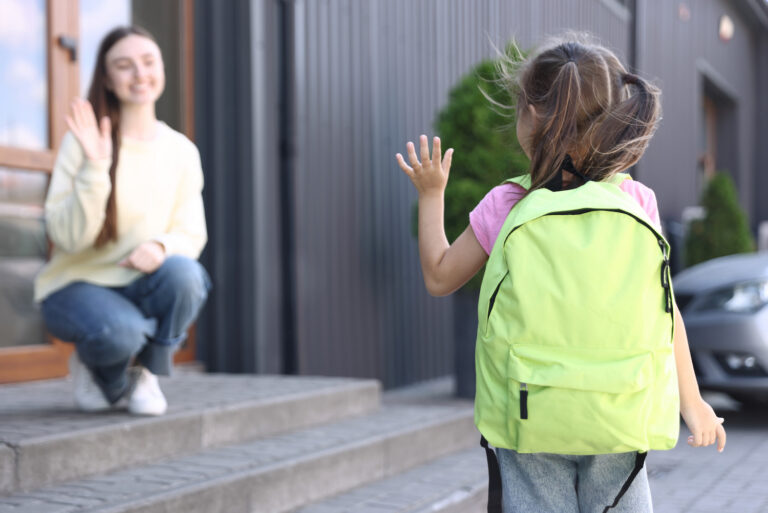
Here’s the part that surprises a lot of parents: the skills teachers actually worry about most in September aren’t academic at all. They’re things like using the bathroom independently, getting a coat on without help, separating from a parent without a meltdown, and taking turns with another kid over a toy. Understood’s list of kindergarten-readiness skills includes exactly these self-care basics, alongside the ability to interact with peers and manage the small daily friction of sharing space with other children.
NAEYC puts it plainly: readiness isn’t a state of knowledge, it’s a state of mind. A child who’s confident, curious, and able to bounce back from a hard moment is often better positioned for kindergarten than one who’s memorized the alphabet but falls apart when a friend takes their pencil. Zero to Three pre-school has spent years pushing this same idea, describing traits like self-control, curiosity, and the ability to communicate needs as the actual building blocks of school readiness, not an afterthought to academics. That’s worth sitting with, especially if your child still needs help with buttons or still cries at drop-off some mornings. Both of those things are normal, and neither one means a child isn’t ready.
Getting Ready for School Without the Spiral
The honest version of getting ready for school is less dramatic than the back-to-school marketing suggests. It’s daily repetition, not a summer bootcamp: tracing letters a few minutes at a time, practicing two-step instructions during chores, letting a kid struggle with their own zipper instead of doing it for them.
None of this needs to look like a curriculum. It needs to look like a few unhurried minutes a day, the kind that builds a child’s fine motor skills, attention, and confidence at the same pace, so that by the time September rolls around, ready isn’t a milestone they’re racing toward. It’s just where they already are.